
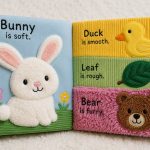
Textured baby books with rough, smooth, furry, slippery and bumpy textures turns reading time into sensory and interactive experiences.
How does it contribute to Early Childhood Development?
- COGNITIVE DEVELOPMENT: Initially babies learn through their senses. Different textures give babies opportunities to explore through touch, feel and distinguish between different sensory properties. Early book skills begin to develop as baby learns that books are objects to look at , touch, feel and explore, thus laying the foundation for later reading by themselves. Most important for neural connection (which is how children learn) is that baby begins to connect word, picture and physical sensation.
- LANGUAGE DEVELOPMENT: Reading together gives caregivers opportunities to name objects and textures, creating the foundation for vocabulary-building.
- PHYSICAL DEVELOPMENT: By reaching, grasping, rubbing, patting and eventually using their fingers to explore textures, baby starts to develop fine-motor skills, necessary for later handwriting. Hand-eye coordination is also important as baby can practise connecting what they see with what their hands are feeling.
- SOCIO-EMOTIONAL DEVELOPMENT: Looking at and exploring books together create opportunities for joint attention, interaction and bonding.
When are textured books suitable?
Textured books can be used from birth. Initially, the baby looks at the pictures whilst the caregiver talks and helps baby explore the textures. Later, baby starts reaching, grabbing and holding the book. This leads to later actively exploring textures, mouthing the book, and turning pages. Which leads to deliberately searching for textures, points to objects/textures and begins associating objects with textures. When ready, baby will begin naming the objects and textures.
PLEASE NOTE: Giving an age/milestone for developmental achievement can create an expectation that a child should be achieving a particular skill by a certain age, when in reality children develop at different rates and in different ways. The focus should remain on supporting and enjoying each child’s individual learning and development.
CAREGIVER TIP: Children will show when they are ready to move to the next step of development. If a child is not ready, return to where they are comfortable and provide more opportunities to explore. Try again when they are ready.
OTHER BOOKS THAT ENCOURAGE SENSORY AND INTERACTIVE LEARNING FOR BABIES:
- Finger-puppet books: encourages baby to interact with the story. The caregiver can use the finger-puppet to make an animal (or other) move, dance, hide, show emotions (happy, sad). This helps to capture baby’s attention, encourage eye-contact, listening skills, and language development. Later, baby can get involved by touching the puppet, making animal sounds, and eventually using the puppet themselves.
- Cloth books (with rattles): Cloth books allow babies to grasp, shake, pull to mouth thus exercising big muscle development and hand-eye coordination. A rattle attached to the book or separate allows for grasping (fine-motor skills) of the rattle and auditory stimulation. Rattles also teach cause and effect as baby realises that shaking the book or rattle produces a sound.
